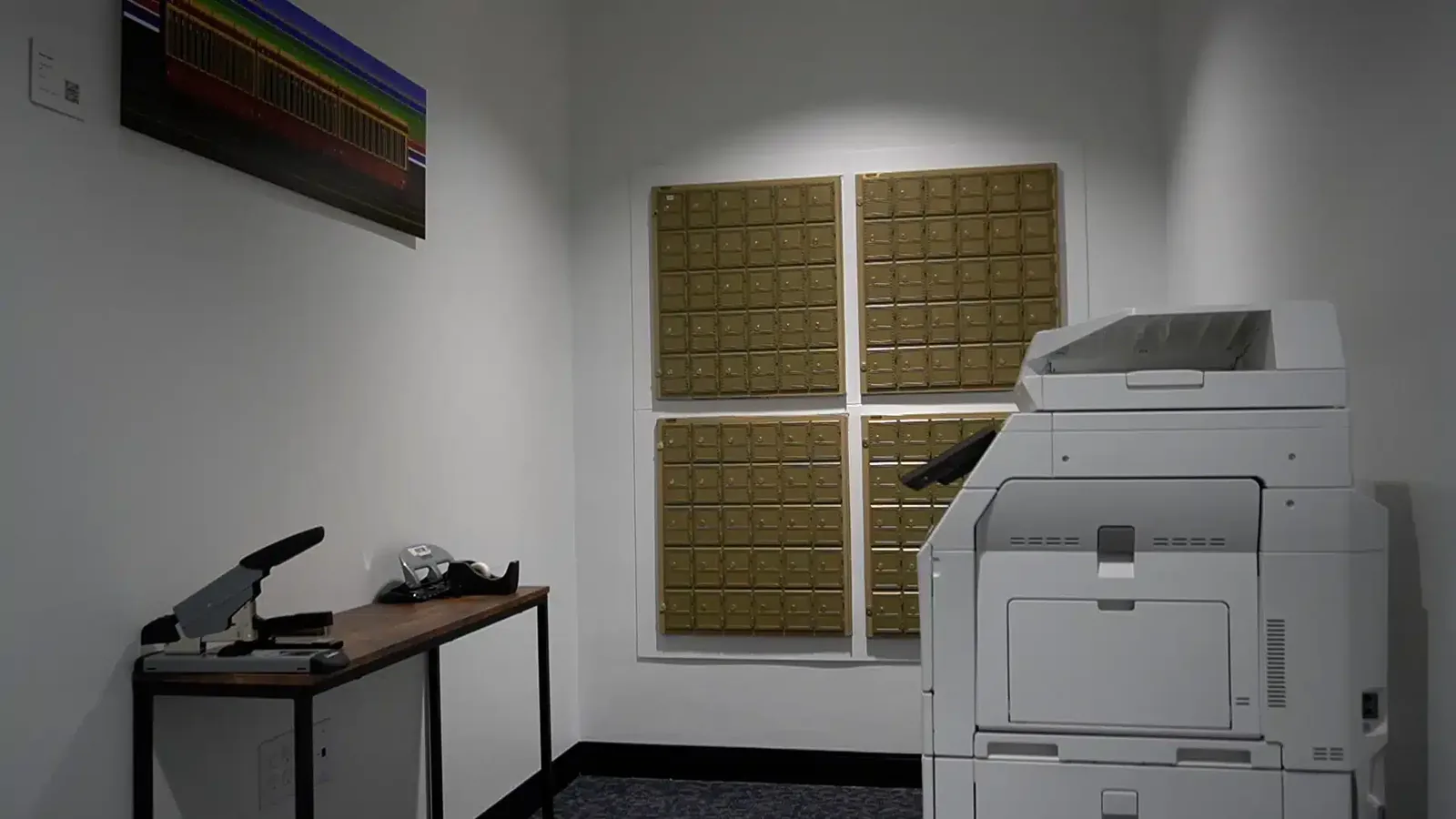
A virtual office in San Antonio gives your business a real commercial address in the city, with professional mail handling and optional access to meeting rooms — without a lease or a daily desk. It exists to solve one specific problem: operating remotely while still presenting a credible, stable local presence.
The short version:
- It provides a legitimate San Antonio business address without a full-time office.
- It supports credibility, compliance, and privacy for remote and service-based businesses.
- It is not a mailbox and not a coworking membership, though it works alongside both.
- It suits professionals who need presence and flexibility, not daily desk space.
- For many businesses it is a low-risk first step before committing to a lease.
What a virtual office actually is
A virtual office is business infrastructure: a real, commercial San Antonio address, professional mail handling, and optional access to physical space when you need it.
Unlike a home address or a PO box, a virtual office address is suitable for public-facing use — business registration, your website, invoices, marketing materials, and client correspondence.
A virtual office typically includes:
- A physical San Antonio business address
- Secure mail receipt and handling
- Mail forwarding, scanning, or pickup
- Optional access to meeting rooms and workspace
What it does not include is a permanent, dedicated office or a daily desk. That distinction is the one most often misunderstood.
Why the address matters more than people expect
The address a business lists is rarely just a formality. It carries real consequences for compliance, trust, and flexibility.
A local address can be required, or strongly preferred, for:
- Business registration and licensing
- Banking and payment processing
- Client contracts and vendor agreements
- Google Business Profile listings and directories
- Client confidence and professional perception
A residential address raises privacy concerns and can complicate compliance. A PO box is rejected outright for some registrations. A virtual office closes that gap with a commercial address tied to a real, staffed location.
For companies serving San Antonio clients — or establishing a footprint here — a local address signals intent without forcing premature overhead.
How it works day to day
Mail arrives at the business address and is handled according to your preference: secure storage, scheduled forwarding, scanning, or in-person pickup. You do not need to be on site for any of it.
When you do need space — a client meeting, an interview, an occasional work day — most providers offer on-demand access to meeting rooms or coworking areas. The result is a hybrid: virtual by default, physical when it matters.
At SA Cowork, that structure lets a business start lean and expand gradually. Members often begin with the virtual office alone and add meeting room time or coworking days later as the business grows.
Does a virtual office fit your business?
You work remotely but need a professional address
Consultants, coaches, agencies, and independent contractors often work from home or travel constantly. A virtual office provides a stable address without tying the business to one daily location.
You serve clients locally but do not need daily space
Many service businesses meet clients occasionally, not every day. Renting a full office for infrequent use is inefficient. A virtual office plus meeting room access usually covers it.
You are launching or restructuring
Early-stage companies benefit from keeping overhead low while establishing legitimacy. Registration, branding, and operations can all move forward without a long-term commitment.
You need privacy and separation from home
A home address on public filings blurs a boundary that is difficult to restore. A virtual office keeps the two separate.
You want flexibility during a transition
Businesses downsizing, relocating, or testing a new market use virtual offices to hold continuity while decisions are made.
Virtual office, home office, or traditional lease
Virtual office — public-facing address, strong privacy, low monthly cost, no long-term commitment, professional mail handling, on-demand meeting space, and easy to scale.
Home office — sometimes usable as a public address, weak privacy, low cost, no commitment, self-managed mail, limited meeting space, and limited room to grow.
Traditional office — public-facing address, strong privacy, high monthly cost, a multi-year commitment, on-site mail, dedicated meeting space, and little flexibility.
That middle ground is the reason virtual offices exist: legitimacy and flexibility without the cost and rigidity of a lease.
Four common misconceptions
"It's just a mailbox."
A virtual office address is tied to a real commercial location with staff, not a postal box. That distinction matters for both compliance and credibility.
"It's the same as coworking."
A coworking membership includes regular access to shared workspace. A virtual office is about address, mail, and occasional access. They complement each other; they are not interchangeable.
"Clients will think it's fake."
Clients see a legitimate business address in a professional building. In practice, almost none ask whether you are on site daily.
"It won't work for registrations."
Virtual office addresses are generally acceptable for business registration and correspondence, though requirements vary by industry and agency. Check your state and local guidance for your specific case.
Evaluating a provider
Before choosing, get clear on what you actually need. Ask yourself:
- Do I need the address for registration, client-facing materials, or both?
- How often will I realistically need meeting space?
- What level of mail handling do I require — forwarding, scanning, pickup?
- Is flexibility more important than permanence right now?
Then read the offer carefully: how mail is handled, what access is included, and what upgrade paths exist if your needs change.
Related reading: Virtual Office San Antonio and San Antonio Virtual Offices: Embracing Flexible Workspaces.
San Antonio virtual office FAQs
Can I use a virtual office address for my LLC or corporation?
In most cases, yes. Many businesses use a virtual office address for registration and official correspondence, though requirements vary by state and industry.
Is a virtual office legal?
Yes. Virtual offices are a common, legitimate business service when provided by an established workspace operator at a real commercial location.
Will my mail be secure?
Professional providers use controlled access and documented handling procedures for member mail.
Can clients meet me there?
Yes, where the provider offers meeting rooms or event space that can be reserved as needed.
Is this the same as a registered agent?
No. A registered agent is a specific legal role with statutory duties. Some businesses use both, but they serve different purposes.
Can I upgrade later to coworking or an office?
Usually. Most providers, including SA Cowork, let members add coworking days, a dedicated desk, or a private office as they grow.
Does a virtual office work for remote teams?
Yes. It provides one central business address while the team works from multiple locations.
How much does a virtual office cost?
Substantially less than a traditional lease. Pricing depends on the level of mail handling and how much meeting room access is included.
Will clients know I'm not there every day?
Most clients care about responsiveness and professionalism, not whether you are physically at a desk.
A practical way to establish presence
A virtual office is not a shortcut. It is a deliberate choice for businesses that value credibility, flexibility, and cost control — providing exactly what is needed and nothing that is not.
It lets a company establish a professional presence, protect personal privacy, and adapt as circumstances change, without locking in decisions too early. For a lot of modern businesses, that balance is the whole point.
Set up a virtual office at SA Cowork
SA Cowork's virtual office gives you a business address at 7550 I-10, Suite 1400, San Antonio, TX 78229, with mail and package handling and on-demand access to meeting rooms.
Book a tour or call (210) 985-9749 to talk through which option fits.