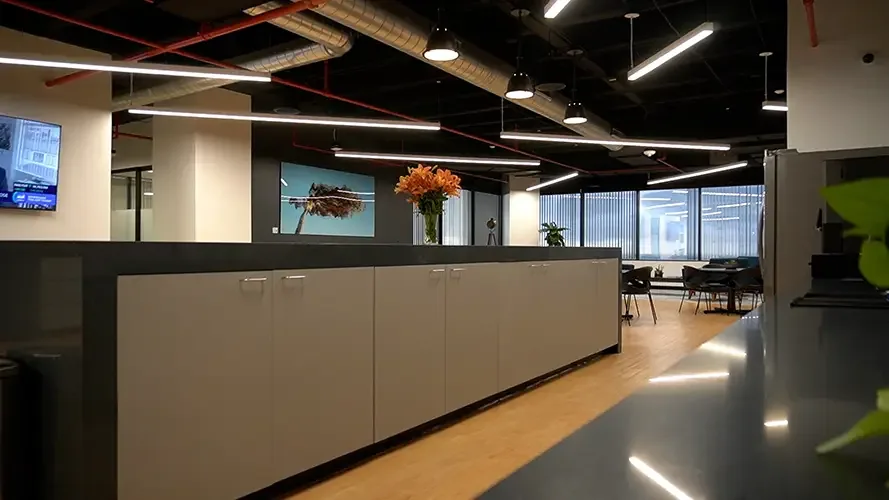
Coworking amenities are best understood as modular office infrastructure rather than perks. The strongest spaces combine a virtual office, shared amenities, and private space into one system a business can move through as it grows — controlling cost and preserving credibility without a long-term lease.
The short version:
- Amenities function as office infrastructure, not lifestyle extras.
- The best models blend virtual offices, shared amenities, and private space into one scalable system.
- Businesses choose coworking to control cost, preserve credibility, and adapt as teams change.
- Flexibility no longer requires giving up professionalism or community.
- Amenities matter most when they integrate with real business needs rather than impressing visitors.
Why coworking, and why now
Coworking amenities allow a business to operate flexibly without losing credibility. The effective spaces combine virtual offices, shared amenities, and private offices into a single workspace strategy, letting individuals and companies reduce risk, control cost, and grow without committing to a lease. In practice, they replace the fixed overhead of a traditional office with adaptable, on-demand resources.
Why this matters in San Antonio
Work has changed permanently, but many office decisions are still made on pre-2020 assumptions.
Hybrid work, distributed teams, and independent professionals are now normal across industries. Those businesses still need legitimate addresses, professional meeting space, and somewhere to collaborate — needs that long-term leases meet inefficiently and expensively.
Coworking matured in response. What once suited mainly freelancers now serves startups, small businesses, and enterprise teams. Amenities stopped being lifestyle branding and became operational resilience.
In a city like San Antonio, where growth spans freelancers, service companies, startups, and regional teams, coworking amenities sit exactly at the intersection of cost control, professionalism, and scalability.
How it actually works
Coworking amenities are shared resources that replace what a traditional office would otherwise require you to own, lease, or manage.
Instead of signing a lease and building out infrastructure upfront, members get:
- A professional business address
- Mail handling at a compliance-friendly location
- Meeting rooms on demand
- Shared collaboration space
- Technology-equipped rooms for calls, content, and presentations
- Community programming and networking
These are layered across access levels. A virtual office provides legitimacy without physical presence. Shared desks provide structure without permanence. A private office provides focus and privacy without long-term risk.
The value is not in any single amenity. It is in how they work together as a system you can move through.
What matters most
Flexibility without fragility
The ability to upgrade, downgrade, or change workspace type matters far more than square footage.
Professional credibility
Address quality, meeting rooms, and client-facing environments signal legitimacy — often before anyone meets you.
Cost predictability
Coworking converts capital expenditure into a predictable operating cost.
Scalability
A good space lets a business grow or contract without disruption or relocation.
Shared infrastructure
Meeting rooms, podcast studios, and collaboration areas remove overhead you would otherwise carry internally.
Community and network effects
Strong spaces produce relationships, not just occupancy. That is where referrals come from.
Location and access
Proximity to clients, partners, and major business corridors still matters — as does parking.
What drives the office decision
Lease flexibility reduces long-term risk; coworking answers it with month-to-month or short-term agreements.
Professional image builds client trust; coworking answers it with a real business address and proper meeting rooms.
Cost control preserves cash flow; shared amenities lower fixed costs.
Scalability supports growth and contraction; upgrades between workspace types are straightforward.
Productivity depends on reducing distraction; a structured work environment does that better than a kitchen table.
Community drives referrals and collaboration; built-in networking and events make it happen.
Four common misconceptions
"Coworking is only for freelancers." Increasingly it supports mature businesses that want flexibility, including established teams and satellite offices.
"Amenities are perks." Coffee bars and lounges are not the value. Infrastructure access is.
"Virtual offices are inferior." A virtual office paired with on-demand coworking access often outperforms a traditional office in early growth stages, at a fraction of the cost.
"Community is a soft benefit." Isolation costs productivity and opportunity more than most businesses account for.
Traditional office versus modern coworking
A traditional office means long-term lease commitments, high upfront buildout costs, fixed square footage, limited flexibility, and internal responsibility for maintenance and infrastructure.
Modern coworking means flexible terms, minimal upfront investment, modular workspace options, shared amenities, and a footprint that scales with the business.
The difference is not convenience. It is risk management.
Building a flexible office strategy
- Start with legitimacy. Secure a professional business address and mail handling.
- Assess real usage. Work out how often you genuinely need desks, meetings, or private rooms.
- Layer access gradually. Add coworking access before committing to a private office.
- Use shared infrastructure. Book meeting rooms and content spaces instead of building your own.
- Scale intentionally. Expand only when demand is consistent, not when it spikes once.
- Engage the community. Attend events and build relationships inside the space.
This sequence minimizes sunk cost while keeping your options open.
A real example: scaling inside SA Cowork
Peachtree Rose Marketing LLC began with a virtual office to establish a professional San Antonio presence. As client work grew, the company added a dedicated desk, then expanded into multiple private offices, and began hosting its own events in the space.
Today the business serves out-of-state clients, contributes to community programming, and uses several coworking amenities as part of daily operations.
Founder Matt Nelson puts the decision plainly:
"I said no to a traditional office space rental because I wouldn't have been able to grow my business or network this quickly in San Antonio without the opportunities and flexibilities offered in this coworking space."
That progression is the point: coworking amenities working as a growth platform rather than a temporary fix.
See how the system works
SA Cowork offers virtual offices, shared and dedicated desks, private offices, meeting rooms, event space, and two podcast studios at 7550 I-10, Suite 1400, San Antonio, TX 78229 — with free covered parking and 24/7 member access.
Book a tour or call (210) 985-9749.