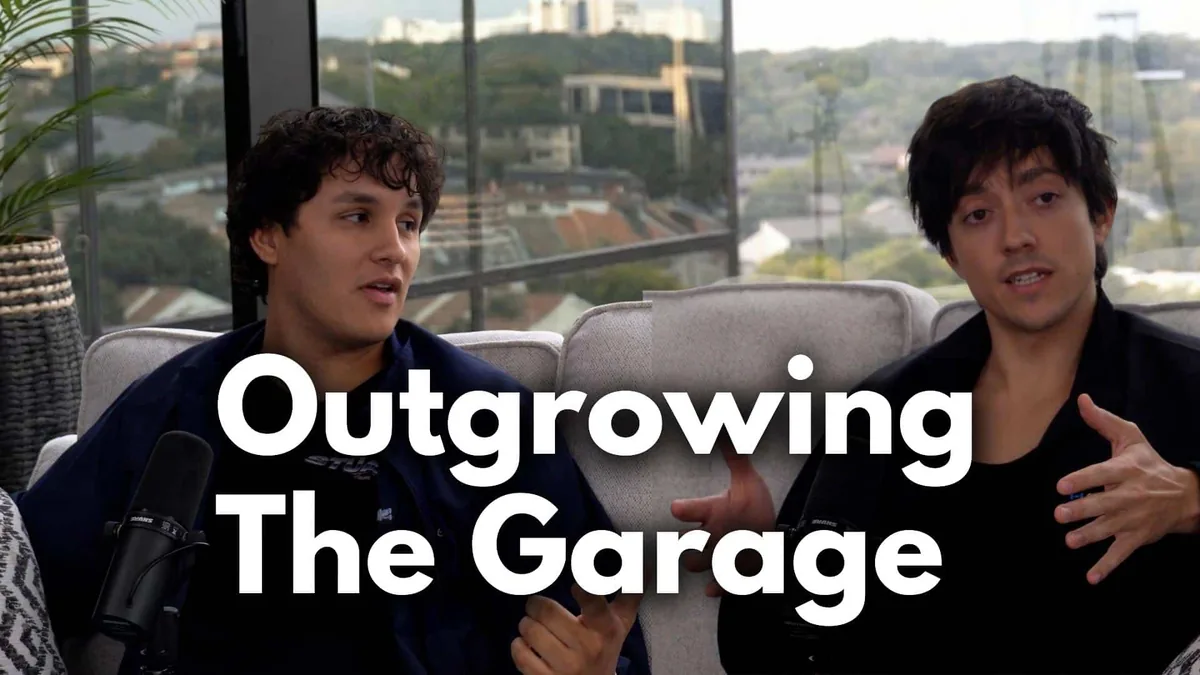
The garage startup is a cherished myth — the next Apple born among cardboard boxes and oil stains. For Sam and Richard, co-founders of Gyraline, the garage wasn't a myth. It was a bottleneck: 3D printers humming in a future nursery, circuit breakers tripping in the middle of the night, and the line between "father," "husband," and "CEO" dissolving completely.
Their move from a home operation to a leading automotive tech brand illustrates something useful for San Antonio's business community. Scaling a startup takes more than a good idea. It takes an environment that makes deep work possible.
San Antonio's hyper-local tech ecosystem
San Antonio is no longer only a tourism and healthcare town. A high-velocity tech corridor has formed in the Northwest, anchored by professional hubs like SA Cowork — defined by proximity to major transit arteries (I-10 and Loop 410), access to a skilled engineering workforce, and a dense network of service businesses.
Why Northwest San Antonio
For a hardware startup like Gyraline — preparing for a showcase at SEMA in Las Vegas — location is a strategic asset. Being ten minutes from the airport and surrounded by other tech-forward professionals is a competitive advantage, not just a convenience.
A business inside the SA Cowork community isn't renting a desk so much as embedding in a node of connectivity. That produces the unplanned encounters that matter: finding a beta tester for a 3D-printed prototype, or a marketing partner who genuinely understands YouTube SEO.
The silent partner effect
In the early days Sam and Richard wore every hat — engineers, janitors, shipping clerks, marketers. Moving into a managed workspace let them offload the mental clutter of running an office.
The space handles the internet, the business address, the front-desk greeting for clients, and the coffee. That frees the founders for the heaviest-hitting work: refining the precision nubs on the Gyraliner, or preparing the G2 sensor suite for a global market.
Engineering precision in a creative space
There's a persistent assumption that coworking is for creatives — designers, writers, social media people. Gyraline is a counterexample: engineering startups do well in these environments.
The hardware paradox
Hardware is notoriously hard to scale. Unlike software, you need physical space for inventory, testing, and production. Sam and Richard started with six 3D printers in a bedroom, deliberately split across separate breakers to avoid taking down the house.
A private office let them scale past 30 printers. Just as importantly, it gave technical work a professional backdrop — clean lines, glass, and modern furniture that match the precision of the product itself.
The psychology of the threshold
Sam described a genuine psychological shift: "Being able to walk into a threshold and say, 'This is where the work happens.' It will change your company's performance."
What deep work actually is
Coined by Cal Newport, deep work is the ability to focus without distraction on a cognitively demanding task. For a founder that's where the real output happens — where code gets written, products designed, strategy set.
The problem with a garage or a kitchen table is the absence of a threshold, physical or mental. When the office sits next to the nursery, the brain never fully enters focus. Part of your attention is always listening for the printer to finish or for someone to knock.
Watch the full interview with Sam and Richard
How the space supports focus and authority
Walking into a dedicated desk or private office gives the brain a clear signal: home is behind you, it's time to build. Several specific things support that.
Quiet zones for deep engineering. Technical founders need uninterrupted blocks to solve hard problems — like Gyraline's move to the G2 sensor suite. Quiet zones are built for that, away from the chatter of an open floor and the interruptions of home.
Meeting rooms for real strategy. When it's time for a serious session — statistical significance, or a five-figure website investment — the room matters. A proper meeting room sets a tone that produces better decisions.
An on-site podcast and media studio. For a technical brand, authority is the currency. To convince a mechanic to trust a smartphone app over a $60,000 alignment machine, you have to demonstrate expertise. The studio lets Sam and Richard explain the physics of particulate matter clearly, show the Gyraliner's precision engineering in high-definition, and repurpose long technical conversations into short-form video — acting as their own media operation without leaving the building.
Ambient accountability. As Richard noted, a professional space makes you far more aware of your time. Being around other people working creates a natural accountability loop — and, usefully, teaches you when to call it and go home.
The Gyraline innovation
Gyraline's story isn't only about a tool. It's about a shift in the automotive industry, and most drivers have no idea their car's alignment is a meaningful source of pollution.
The environmental angle
Sam offered a striking figure: tires contribute nearly twice the particulate matter that the engine does. Exhaust standards have tightened so far that tire wear is now the frontier of concern.
Poor alignment — even 0.3 degrees out — causes non-linear tire wear. Tires get scrubbed against the pavement, releasing particles into the air. A tool that lets any driver check alignment in 30 seconds with a phone doesn't just save money on tires; it reduces what ends up in the air.
Disrupting the shop
For years the barrier to a good alignment was the shop itself: drive over, wait two hours, and trust the technician used the expensive machine correctly. Drivers of lowered cars, Kei vans, or lifted trucks often couldn't get served at all.
Gyraline's approach changes three things:
- Immediacy. Check alignment in a parking lot before a 5,000-mile road trip.
- Universal access. The G2 sensor suite works across Android and iPhone.
- Cost. Avoiding $100 in premature tire wear pays for the tool almost immediately.
The founder's dilemma: delegate or die
A good stretch of the conversation between Audrey, Sam, and Richard concerned the point at which you stop doing everything yourself.
Buying expertise instead of learning it
Gyraline invested significantly in a website overhaul. Plenty of owners would balk at the price, but the founders understood opportunity cost: they could learn to build it, but their hours are worth more spent on engineering. So they bought expertise — conversion optimization, SEO, and answer engine optimization.
Their approach generalizes well:
- A/B test. Don't trust an opinion; trust the data.
- Wait for significance. A 95% confidence interval before declaring a winner.
- Mind the fundamentals. Mobile load speed and search intent decide whether a site competes at all.
Hiring in San Antonio
Scaling takes people. Sam made a sharp distinction: you don't hire someone to take a load off — you hire them to give a task 100% of their energy, where a founder can only give it 10%.
Being in the community gives startups a front-row view of the local talent pool, whether that's a virtual assistant, a marketing consultant, or another engineer.
Continuous learning
Sam and Richard are self-described book nerds, and treat physical books, Kindles, and Audible credits as fuel for the business — from Making Websites Win to reading and listening simultaneously for retention.
They're also clear that you have to stop. Whether it's a stand-up jet ski or just using the amenities, the ability to disconnect is what makes the next deep work session productive.
Watch the full interview
The full conversation is on the SA Cowork YouTube channel, recorded in the podcast studio at Venture X San Antonio Northwest. You'll see the Gyraliner in action, hear the unfiltered reality of running a print farm in a future nursery, watch the founders work through the delegation question, and get the full particulate-matter explanation.
Watch the full interview on YouTube
Step into your growth era
If you're still working from a garage or a noisy kitchen table, you have probably hit a ceiling. Like Sam and Richard, most founders reach a point where the environment has to match the ambition.
SA Cowork at Venture X San Antonio Northwest offers private offices, dedicated desks, quiet zones, meeting rooms, and a podcast studio at 7550 I-10, Suite 1400 — with free covered parking and 24/7 access.
Book a tour or call (210) 985-9749.